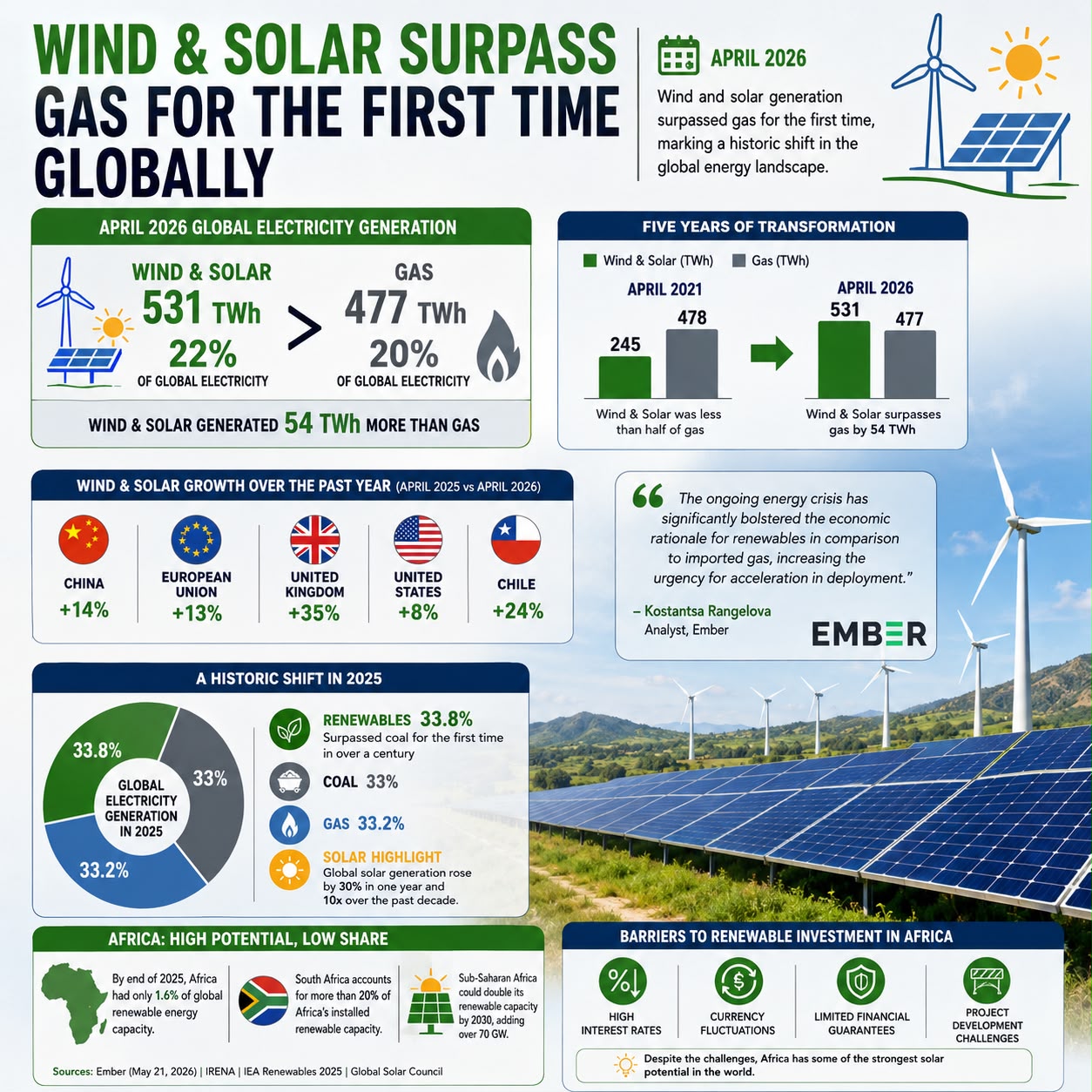
In April 2026, wind and solar energy production surpassed that of gas for the first time globally, as reported in an analysis released on May 21 by the British energy think tank Ember. Collectively, these renewable sources contributed 22% to the world’s electricity output that month, while gas accounted for 20%. Wind and solar generated an unprecedented 531 terawatt-hours (TWh) of electricity, surpassing gas-fired generation by 54 TWh, which stood at 477 TWh. To compare, five years prior in April 2021, gas production was at a similar level, but wind and solar collectively produced only 245 TWh, less than half of the current figures.
Ember’s findings indicate that the combined generation from wind and solar has risen by 13% on a global scale over the past year, with significant growth reported in several regions: China (+14%), the European Union (+13%), the United Kingdom (+35%), the United States (+8%), and Chile (+24%).
This milestone occurred during a particularly advantageous month for renewable energy generation. The Northern Hemisphere experienced strong sunlight during April, coinciding with favorable wind conditions. Additionally, electricity demand typically decreases in spring due to limited heating and cooling requirements, which in turn reduces the reliance on gas generation.
Moreover, Ember notes that this achievement signifies more than just favorable seasonal trends. According to Kostantsa Rangelova, an analyst at Ember, “The ongoing energy crisis has significantly bolstered the economic rationale for renewables in comparison to imported gas, increasing the urgency for acceleration in deployment.”
Annual statistics also illustrate a profound shift in the global electricity landscape. In 2025, renewable energy sources accounted for 33.8% of total electricity generation, surpassing coal’s 33% share for the first time in over a century. Solar energy significantly contributed to this growth, with global solar generation rising by 30% within a single year and increasing tenfold over the last decade.
However, Africa continues to lag in this global transition. By the end of 2025, the continent represented only 1.6% of global renewable energy capacity, as indicated by the International Renewable Energy Agency (IRENA). South Africa was responsible for more than 20% of Africa’s installed renewable capacity, yet the continent possesses substantial potential for renewable energy expansion. The International Energy Agency’s Renewables 2025 report suggests that sub-Saharan Africa could potentially double its renewable capacity by 2030, adding over 70 gigawatts (GW).
Nevertheless, various obstacles impede project development throughout Africa. The Global Solar Council identifies high interest rates, currency fluctuations, and limited financial guarantees as significant barriers to investment. Despite these challenges, Africa is endowed with some of the strongest solar potential globally.